Automatic language translation
Our website uses an automatic service to translate our content into different languages. These translations should be used as a guide only. See our Accessibility page for further information.
Justice Reinvestment is an approach that supports Aboriginal communities to find local solutions to local issues. The aim of Justice Reinvestment is to resource communities to develop and deliver solutions that reduce the contact of Aboriginal adults and young people with the criminal justice system, including the police, courts, and prisons. Justice Reinvestment initiatives:
While Justice Reinvestment is about Aboriginal-led solutions, it is also about government supporting communities to identify issues and develop a plan for appropriate change. Government support can include:
The Department of Communities and Justice (DCJ) acknowledges the interconnectedness of Justice Reinvestment initiatives with other programs including Stronger Places, Stronger People, Local-decision Making through Aboriginal Affairs NSW, Aboriginal Justice Partnerships and other place-based initiatives.
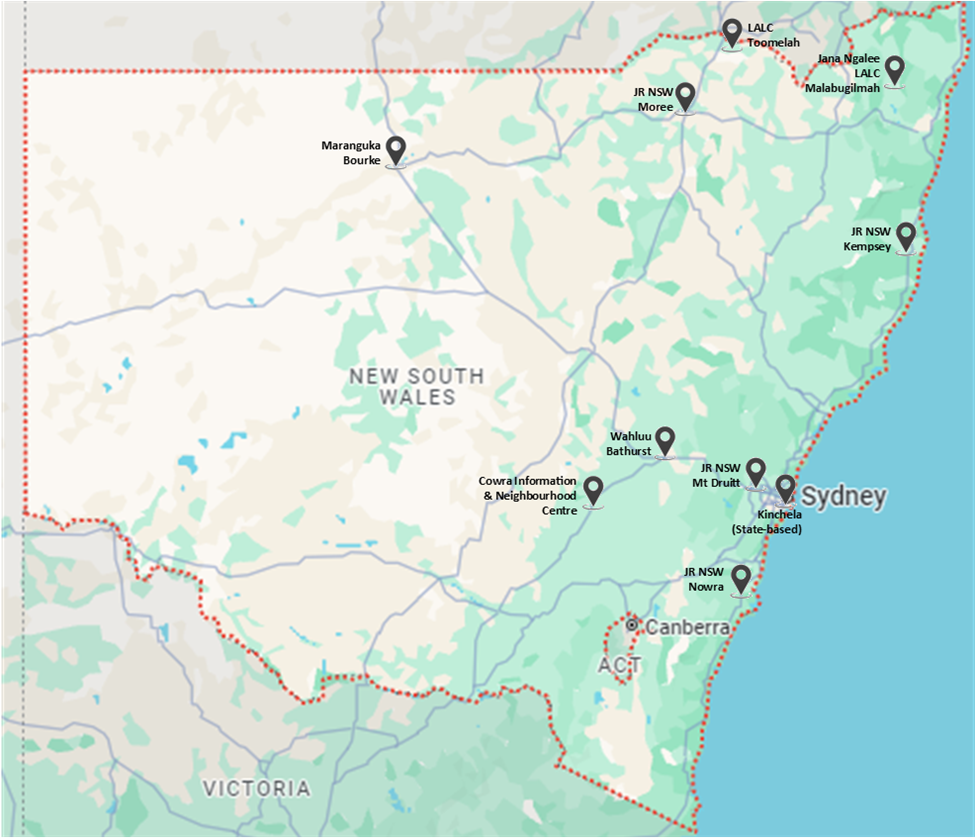
DCJ currently funds six Justice Reinvestment sites in NSW.
There are ten NSW Justice Reinvestment sites in total, they are supported through a combination of investments from the DCJ Justice Reinvestment funding package, the Commonwealth National Justice Reinvestment Program and philanthropic funding.
On 18 July 2022, the NSW Government committed a funding package of $9.8 million to expand Justice Reinvestment in NSW.
As part of this funding commitment, in 2023, DCJ funded Just Reinvest NSW $2.5 million to expand Justice Reinvestment initiatives in Kempsey and Nowra from June 2023 to June 2027.
Led by the Dhina Durriti Aboriginal Corporation, Justice Reinvestment work is part of the Learning the Macleay initiative. Learning the Macleay is driven to strengthen young people, adults and elders on Dunghutti Country to heal, belong in their connection to culture and country, and to be safe. The current draft Theory of Change includes three overarching aims: Healing, Educating and Aligning. Learning the Macleay also supports the community to learn, grow and respond to challenges in the Macleay Valley.
Led by Waminda South Coast Women’s Health and Wellbeing Aboriginal Corporation. Waminda will build the Justice Reinvestment backbone team, including the Justice Reinvestment Manager and the Community Data Lead. The team will establish the Community Leading Justice Reinvestment group. The work will interpret and use regional data to inform solutions to local issues. Waminda will also develop local justice circuit breakers based on community input and local data.
In January 2024, the NSW Justice Reinvestment Grant Program was announced, which offered up to $7.5 million in funding to Aboriginal communities in NSW to undertake Justice Reinvestment initiatives.
Through this Grants Program, four communities received funding over three years from June 2024 to June 2027.
The assessment panel consisted of senior representatives from DCJ, Aboriginal Affairs NSW, the Aboriginal Legal Service NSW/ACT and the NSW Coalition of Aboriginal Regional Alliances.
More information about the Justice Reinvestment Grants Program can be found on the NSW Grants and Funding website.
Grant recipients are:
The team are working to reduce interactions between young people and police in Mount Druitt by providing avenues for community engagement and cultural connection. Key initiatives include the establishment of an Aboriginal-controlled youth service to provide holistic support for young people, and the forging of strong connections with local service providers including police, courts, housing and mental health services.
Under the guidance of the Toomelah Community Justice System Advisory Group, Toomelah LALC will work to reduce youth contact with the justice system through culturally safe early intervention. Initiatives include a night patrol run by local Elders and youth workers, youth cultural programs, as well as a range of other integrated support strategies designed to help young people and their families living in the northern NSW towns of Toomelah and Boggabilla.
The Jana Ngalee LALC are facilitating a community-led diversionary program that aims to re-direct people away from the justice system in the remote Aboriginal communities of Malabugilmah and Jubullum, located in the Clarence Valley. Key activities include the establishment of local Aboriginal-led governance to identify and drive place-based change, and the establishment of a Transformational Hub to deliver culturally appropriate education, training, coaching and mentoring.
Overseen by local Elders, Traditional Owners and other community leaders in the Bathurst area, Wahluu Health Aboriginal Corporation are coordinating the Wundirra Community Centre. Supported by local health, legal and housing services, the Centre will be a culturally appropriate, dependable space for Aboriginal community members that fosters well-being and empowerment while addressing the root causes of contact with the justice system.
The NSW Government is committed to working closely and collaboratively with Aboriginal communities to achieve the targets under the National Agreement on Closing the Gap.
Specifically, Justice Reinvestment works towards achieving:
DCJ is working towards building the connection of this work with the Closing the Gap Priority Reforms.
If you have questions, we’d like to hear from you. Please email justicereinvestment@dcj.nsw.gov.au.
Last updated: